Life Cycle Financial Planners, LLC

Author: Ted Bernstein

  • The Consumer Guide To Indexed Universal Life Insurance, IUL.

    The Consumer Guide To Indexed Universal Life Insurance, IUL.

    Indexed universal life insurance (IUL) is an innovative, low risk type of permanent life insurance. It is primarily intended for people interested in long term life insurance coverage and tax favorable distributions, typically during retirement. These policies are well suited for life insurance buyers seeking large policies, known as jumbo life insurance policies. For premium financing, some consumers prefer to use an indexed product (see reasons below). The use of indexing strategies guarantees there will a loss of cash value when markets are down. No market losses makes IUL an appealing product for risk averse consumers. The fact that 0% is the lowest crediting rate possible makes it worthy of consideration, especially when the stock market is down 30%. The interest credited to IUL policies will never be below 0%. In fact, some products guarantee a floor of one or two percent.

    Do IUL policies reduce risk for life insurance buyers? Since none of the policy’s cash value is ever invested directly in the stock market, it does provide a buffer against normal market volatility. “Zero is your hero” feels pretty good when markets are down 25%. Market losses during these market cycles can be quite damaging.

    We might think that dynamite and an IUL insurance policy are nothing alike. One is an explosive and the other is often described as another boring type of life insurance policy. While that may be true, in the wrong hands, dynamite can be catastrophic. In a professional’s hands, dynamite can be part of a well controlled plan to bring down a multi-story building without much of a fuss. In the wrong hands, an IUL policy can make a big mess and create nothing but unintended future problems. Properly used by a professional, an IUL policy can be the ideal product choice. Not all buildings should be brought down with dynamite and not all insurance plans call for IUL.

    The use of indexing strategies may result in buying a policy with the lowest possible net cost of any policy measured in the medium and long term. Of course, this depends on how markets perform, the sequence of returns, how the policies are credited and how often and when the insurance companies lower the cap or participation rates. In order to achieve optimal returns, a greater level of understanding and responsibility by the policyowner is essential. It is definitely not a set it and forget it type of life insurance policy, unlike whole life. With the proper amount of education, indexed universal life is suitable for the following insurance buyers:

    • Between ages 25-55 (ideally).
    • Want permanent life insurance.
    • Appreciate flexibility.
    • Consistent, high income.
    • High net worth.
    • Interested in retirement income.
    • Considering premium financing.
    • Willing to routinely review inforce policies.

    Like other permanent life insurance contracts, IUL builds up tax deferred cash value when interest is credited to the policies. A number of well-known indexes, such as the S&P 500 or the Nasdaq-100 are typical indexes options. There are no government imposed restrictions or limitations on contributions or distributions, like there are with qualified retirement plans. The cash value can be accessed without penalties or taxes, unlike a 401(k) or IRA. These policies are often used as private pension plans by people without access to a corporate pension plan.

    There are policy expense charges and fees in IUL policies that should be understood by the agent and the policyowner. In good contracts, the fees are capped, which means they are less impactful as the premium levels increase. Indexed Universal Life is not a good alternative to term insurance or other products that do not build up cash value. It is most beneficial for younger consumers who want permanent insurance, flexibility, strong potential upside and tax free withdrawals near retirement.

    The advantage of a policy that guarantees to never lose principal due to market performance can be compelling. Another reason for IUL’s popularity is because it is a powerful tool that smooths out returns. “The key to minimizing sequence of return risk is to reduce volatility, which IUL does far more than the S&P 500”, says Sam Rocke, SVP at Ash Brokerage.

    Insurance companies share in the index’s upside when markets are up. They do this with simple cap rates and/or participation rates. For example, if the S&P is up 20% one year, a policy with a cap rate of 12% will credit the policy with 12% interest that year. Essentially, cap rates and participation rates create a partnership between policyholders and the insurance company. The insurance companies take all the risk.

    The results are impressive as consumers are flocking to the safety of indexed universal life insurance. The product had $2.3 billion in sales for 2019 and the first half of 2020 saw more of the same record breaking growth.

    Why Universal Life Insurance?

    The retirement vehicle for many corporate employees is a 401(k). There is market risk with 401(k)s which is fairly well understood by individual investors. In addition to the market risks they assume, there are contribution limits, taxes that are deferred until withdrawal time as well as substantial recurring fees. For many, a 401(k) may not be the perfect retirement solution, by itself. Near retirement, the loss of principal is too costly. For others, they want the option to make flexible and much larger contributions than 401(k)s or IRAs allow. For these people, an indexed universal life policy can be an excellent addition to the other investment vehicles.

    The stock market is volatile and it has been known to punish short term and medium term investors. Once people can see retirement in their future, a growing number of them begin to feel differently about the inherent risks in the stock market. Principal protection quickly becomes their main concern, rather than maximum yield. Yield is undoubtedly important, but an extra 1% is not worth exposing principal to drops of 30%.

    What are the costs? Funded properly, these policies should have sufficient internal growth to offset the increasing cost of insurance charges and other internal fees. The current cost of insurance expenses and fees are subject to change and they are deducted from the cash account each year. Managed and funded properly, the account values should outpace annual deductions. I have many younger IUL clients who began funding their IUL contracts with oversized premium contributions. They benefit in two ways by doing that. Overfunding creates a cushion of cash value that can be used if income takes an unexpected hit and overfunding in good years can help in smoothing out the returns.

    What is Universal Life? Some history about this product is beneficial. In the 1970’s, the rate of return of whole life insurance was 2-3%. When interest rates shot up to historic rates in the late 70’s and the 1980’s, EF Hutton created a flexible, interest sensitive product to compete against whole life. Other life insurance companies followed, with some crediting more than 12% at the time. Sales of universal life were meteoric. Billions of premiums poured into these contracts. As a young agent during this time, there was insufficient agent education about the impact of interest rates on long term policy performance. Policies sold based on double digit projections were destined for trouble.

    As interest rates gradually decreased, new projections should have been provided to policyholders, by their agents. If a policy was purchased using illustrations based on 10% assumptions, it should have been re-projected again when rates fell to 6% and again when rates fell to 4% and again when they fell to the guaranteed rates in the contract. LOWER INTEREST RATES WILL CAUSE THE POLICY TO NEED MORE PREMIUM TO MEET THE PROJECTIONS THAT WERE BASED ON HIGHER RATES. WHEN THESE POLICIES WERE NOT FUNDED WITH THE HIGHER PREMIUMS NEEDED TO OFFSET THE LOWER CREDITING RATES, THE POLICIES TURNED INTO TICKING TIME BOMBS.

    Adding insult to injury, when the looming crisis in a policy isn’t detected, it may leave the policyholder with no options. It’s like driving towards the edge of a cliff in the dark. You have no idea until it’s too late. The problem happens faster for older policyholders. For most agents, companies and policyholders, these were tough lessons. They taught us the value of regular reviews and to project life insurance conservatively. Things change that affect policies. The problem is not universal life. The problems were aggressive insurance company projections, insufficient agent education.

    Indexed universal life (IUL) is not a “set it and forget it” type of policy to own. There are other policy types that are much easier to manage. Every potential IUL buyer should only work with an experienced life insurance professional familiar with indexing strategies. Choosing the right life insurance company is more critical than ever with this type of policy. Some companies are new to IUL and others have been real innovators and pioneers over the past 20 years. These are things the right life insurance professional will share with you.

    In addition to death benefit and cash accumulation, some IUL contracts offer living benefits or accelerated death benefit options. Simply, this gives policyowners the ability to tap the face amount of the policy for health and medical purposes such as chronic or terminal events. Most of the good policies out there make these features available at no extra cost. There is no reason to consider a policy without accelerated benefits.

    Indexing Strategy Offers Best Of Both Worlds.

    Most people may know that the stock market index has returned approximately 8% over the long term but less than 4% for average investors over the same time frame.

    A variety of reasons are attributable for this gap. The biggest factor is emotion. Investors make all types of investment mistakes for many different reasons. Some are due to panic and some are due to their understandable inability to devote enough time and attention. Not only do investors have to be willing to commit the time, they also have to be ready to act every time action is required. Too many find that impossible while they are working, running businesses and caring for families.  

    Individual investors can never take their eye off the ball. Failing to buy and sell at the perfect times make it impossible to attain the average long term historical rates of return.

    Timing the market is tough, even for professionals. When mistakes occur, they impact the overall yield. Warren Buffett says the first rule of investing is to never lose money and he’s right. But to do that, you must be laser focused at all times. Using an IUL prevents investors from ever losing money due to stock market returns.

    IULs have a minimum rate of return, usually between 0% and 2%. For example, if you have $200,000 in a stock account and it drops 20%, you will be down by $40,000. The account value starting in the next year would be $160,000 (minus any fees). In the IUL policy, the same 20% market loss would result in the cash value remaining at $200,000 (minus any fees). 

    The Concept of Stacked Gains. The importance of stacked gains can not be stressed enough when markets are up. A 10% gain in the following year would result in new interest being credited to the policy in the amount of $20,000, putting the policy’s value at $220,000 at the end of the second year. In the stock account, there would be $160,000 plus the same 10% for year two growth (minus fees). The stock account value at the end of the second year would be $176,000 (minus fees).

    The comparison is $220,000 in the IUL versus $176,000 in the stock account. From that point forward, the new base in the IUL is $220,000, never to go lower than that from market losses. Over time, protecting your principal from market loss, makes a huge difference in the policy’s accumulated savings. The cash value in an IUL can drop due to cost of insurance charges and/or fees. It shouldn’t happen but it is something to discuss with a life insurance professional at the point of purchase.

    The Upside (cap rates) and the Downside Protection (the floor).

    If never losing any principal due to negative market returns still sounds too good to be true, let’s peel back the onion a little bit. Quite simply, they are buying options to insure the downside guarantee that your policy will never lose principal from market losses. Life insurance companies employ some of the sharpest minds in the investment world to manage these assets. The people they have working for them are dedicated to nothing else. There can be billions of dollars allocated in these strategies.

    Life Insurance Premium Financing

    Using IUL contracts for premium financing is another strategy we use when it is appropriate for individuals to finance a policy. Today, it is the lure of low interest rates that makes financing a consideration. Premium financing should only be for high net worth individuals with at least $5,000,000+ of net worth. A person who needs permanent life insurance but does not want to use their own capital to pay the premiums is a good candidate for premium financing. An arbitrage should exist between the cost of the premium finance loan and the policyowner’s return on investment. For example, HNW people with an ROI of 10% on their assets can borrow the premiums today at 2% and for them, that may be ideal. That creates an 8% arbitrage and some lenders will gladly lock in longer term rates with favorable terms.

    The goal of a premium financing strategy is to pay off the loan and be left with a properly funded life insurance policy, payable at death. With more than 30 years of premium finance experience and having placed over 600 financed policies, I have strong relationships with traditional lenders and specialty lenders that work with our clients to finance these policies. Many of our clients have their own banking relationships and they prefer doing business with them. In those cases, our job is to guide them through the insurance company requirements. You can learn more about premium financing here

    Policy Design

    The way in which an IUL is initially designed is determined by the goals and objectives of the policyholder. For example, when using the policy to maximize tax-free income in retirement, the policy should be maximum funded, meaning the initial death benefit is low. A lower death benefit will result in less cost of insurance charges.

    Is there a “best index or design” to choose? There is no way to know which indexed strategy will perform the best, either over the long term or the short term. We encourage our clients to work with professionals who will follow “best practices” when recommending index strategy allocations. That includes proper understanding of the index choices in order to make the right decision about which fund or funds to select.

    Taxation – Indexed Universal Life Receives Favorable Tax Treatment which should be discussed with your insurance professional. Qualified plan distributions from a 401(k) and an IRA are subject to income tax while the death benefit is income tax free. If an estate is large enough to trigger estate taxes, the policy can structured in trust to avoid estate and gift taxes.

    Loans are not income, according to the IRS. Therefore, any withdrawals taken as loans are not taxable. For retirement purposes, this is advantageous as the distributions from your IUL are not reported on your income tax returns because they are not treated as income. As a result, this money does not affect your social security taxes or Medicare. 

    The IUL Loan Structure

    Tax-free loans are one of the most compelling reasons to consider IUL, especially for retirement income planning. Indexed Universal Life has different loan types, including an indexed or participating loan. The discussion of policy taxation and loans are important ones and a web page is not a sufficient resource to explain these loans. A web page is good for reference but to cover this topic in the best interest of policyholders, it should be done person to person.

    Considerations:

    • Tax-free distributions and death benefits
    • Guaranteed principal protection during negative market returns
    • Maximum flexibility
    • Favorable policy for premium financing
    • Unstructured loans
    • Stacked gains from indexed growth
    • Less risk
    • Caps and participation rates are not guaranteed
    • Decreasing surrender charges
    • Creditor Protection (varies by state law)
    • Living benefits
    • Financially strong underwriters

    Please contact me at 561-771-4647 or email me to arrange a complimentary consultation about anything on your mind concerning life insurance, annuities or retirement planning.


  • Plan to Succeed.

    Plan to Succeed.

    As an advisor to families, individuals and businesses for many years, I’ve been inspired by the following tips, all of which have stood the test of time.


    1. Shakespeare said “the world’s a stage”. As such, it pays to have a plan, work from a script. But, things happen and when they do, it is okay to go off script and improvise.

    It is always good to set goals and work a plan for achieving them. In your plan, try to remember that so much is not in our control. Things like prosperity, wealth and poverty are not always correlated to the choices we make. They may be influenced by our choices, but sometimes they’re not. Try not to underestimate the role of chance in life as it applies to you, and others. Realizing it may help you go off script at important times. The ability to handle the unexpected without melting down is a good skill to possess.

    While the rewards of hard work often do lead to success, what about the fact that not all success is a result of hard work? What about the fact that not all poverty and failure is due to laziness or other negative labels we ascribe to ourselves, and others? Be kind.

    I can tell you with great certainty that a career or a job with flexible hours and a short commute never gets old.

    2. A great benefit of having money is gaining the ability to control time and make the most of it.

    The ability to do what you want, when you want and with whom you want, creates a lasting sense of happiness that no amount of “stuff” will ever outweigh. 

    Being able to retire on your schedule is one of life’s great luxuries, for some. We tend to work towards a previous ideal that retirement is a virtue in and of itself. For some, it may be. Is a typical retirement a healthy decision for everyone? Perhaps it is not. Many people love what they do and wouldn’t consider retiring at an arbitrary, predetermined point in life.

    3. It’s easy to spoil our children, easier with grandchildren. Teach them well.

    Working with many families throughout my career, I’ve been blessed to see a few that seem to effortlessly produce children with fantastic values. It’s not all luck and genes, that’s for sure. They’ve taught their children well and they tend to make the tough choices when it’s necessary to make them. For example, it is difficult to fully grasp the value of a dollar without earning your own and experiencing its scarcity.

    Teaching children they can’t have everything seems to be the best way for them to learn and understand the difference between “I need” and “I want“. This, in turn, teaches them about budgeting, saving, and knowing the value of what they have and what they want. Delayed gratification is painful to experience and equally as painful to teach.

    Another wonderful lesson for young children is learning to appreciate frugality — within reason. It is an essential life skill that pays off during life’s inevitable ups and downs.

    4. Financial success doesn’t always come from big moves.

    Managing money successfully is a long game and it requires long term discipline and strategy.  You don’t have to hit home runs all the time to end up ahead – not screwing up too often is just as important in reaching your long term investment goals. Like I tell my clients, “you must avoid losses in retirement because you can’t replenish”. Avoiding catastrophic investment mistakes will keep you on track.

    5. Live within your means.

    The ability to live within your means is powerful financial discipline. You will have less stress when other things go south, like income or investment returns. How much you make doesn’t determine how much you have, and how much you have doesn’t determine how much you need.

    6. A changing and open mind is healthy; be flexible.

    During your lifetime, it’s okay to acknowledge that your beliefs and goals will evolve. Thinking about your first college major is a good example of how our goals change during our lifetime. Allowing yourself to change your mind is a superpower, when you’re young and when you’re older. Ronald Reagan was a democrat when he was young.

    7. Everything has a price.

    The price of a career is time. The time spent to develop a career usually comes from your time with friends, family and other relationships. The price of inactivity is poor health later in life. The price of spoiling kids is setting them up to live a disappointing and sheltered life.

    Everything worthwhile has a price and the payment often comes due much later. Most things we want are worth it, but we should know their price and never ignore their true costs. Once we accept the true cost of things, we begin to view relationships, autonomy and creativity with greater value.

    8. Money is not the greatest measure of success.

    Money doesn’t provide the things you want most. No amount of money can bring your perfect spouse, a good character, contentment and empathy towards others. In fact, in retirement, the amount of guaranteed lifetime income is the true measure of success and security, not the amount of one’s assets. ROI in retirement means Reliability of Income.

    9. Don’t blindly follow advice without considering the source (unless it’s mine).

    Many of life’s lessons are things we look back and say we wish we’d learned earlier in life. Never take anyone’s advice without reflecting upon your own values, goals and life experiences. Try to consider as many sides of an issue as you can.

    10. The Concept of tzedakah, or being charitable.

    The Hebrew word tzedakah means charitable and “righteousness”. Being charitable creates a sense of righteousness from within. When we are acting charitably, we should gain self-esteem. I can not imagine a scenario in which the world does not benefit from acts of tzedakah. Charity is manifested in endless ways. For some, using their wealth is how they wish to be charitable. For others, money has nothing to do with money. Instead, some give their time.

    Please call me at 561-869-4500 or email me, Ted Bernstein, about a complimentary consultation. 

  • Term Life Insurance Comparison Tips

    Term Life Insurance Comparison Tips

    Use These Simple Tips To Compare Term Quotes Or To Compare An Existing Term Life Insurance Policy To A New Quote.

    Start by determining how many years of coverage remain in your CURRENT policy? For example, if you bought a 20 year term policy in 2015, it now only has 15 years remaining because it ends in 2035. In essence, you have a 15 year term policy. Next year, it will be a 14 year term policy. To get an apples to apples comparison, you need to compare the cost of a new 15 year term policy to your current premium payment.


    How long is your current policy convertible without new evidence?
    This is the most important provision in your existing policy and what you need to know about a new policy. Most people are unsure about the conversion deadline in their current policy. The conversion option matters. It allows the policyholder to switch from term insurance to permanent coverage, without new evidence of insurability. It is critical for anyone with health changes to be aware of this date.


    Make a list of any other features in your current term policy.
    For example, does your current term policy allow you to take a lump sum advance against the face amount of the policy, at no cost? Nobody should own a policy today without accelerated benefits. Another option is a return of premium. It pays you all your premiums back if you stay in the policy to the end. These are just some features that may not have been available when you last bought coverage.


    Base the new quote on a realistic assessment of your current health.
    Getting the best possible underwriting class results in big premium differences. The annual premium differences for Preferred vs Standard can be 20% or more.


    WITH THIS INFORMATION, YOU WILL BE ABLE TO EFFECTIVELY COMPARE THE DIFFERENT POLICIES AVAILABLE TO YOU! Share the information with the agent you trust to obtain these quotes for you. In no time, the numbers tell the story. Maybe you can reduce your cost or maybe you can spend the same and get a policy with more years and more benefits. You will be surprised at how much better new policies are today.


    Get A Quote! Please call us at 561-869-4500 or email Ted Bernstein, about a complimentary phone consultation.

  • Why is the stock market going up even though businesses are closed and unemployment is skyrocketing?

    Why is the stock market going up even though businesses are closed and unemployment is skyrocketing?

    Read Martha Stokesanswer to How is it the stock market keeps going up even though half the businesses in America are closed down and unemployment rate is skyrocketing due to coronavirus?

    “You have asked an excellent question. Thank you for asking. The Stock Market is in a Bear Market even though the Financial Services Industry would prefer that the average American not know this reality.

    Below is a chart of the S&P500 which is an index of the largest and most important corporations in the US. There are actually 505 companies issues in this index. It is formulated and averaged so it is not the total price of all of these but a value based on this quantitative formula. This is a Monthly Chart so that you can see that this is indeed a Bear Market and that is is just beginning. The monthly chart provides enough data so that you can see the prior two most recent Bear Markets also. The Bear of 2000–2003 and the Bear of 2007–2009. And at the far right hand side, the current bear of 2020 -______.

    There were also the SARS epidemic of 2002, and the H1N1 Flu Pandemic of 2009. So all 3 Bears had either had a serious new novel virus develop at some point in the bear cycle. Now, please remember that technical analysis is NOT a predictive tool. It is a graphical tool that uses historical data to study prior market activity to understand the current situation. Every Bear Market is unique but every bear market has similarities to past bear markets. Studying 120 years of bear markets, the average bear loss is 50%. The duration is average 1.9 years depending on the speed of the loss. Slower bear declines last longer, fast steep bears are shorter in duration.

    The Stock Market LEADS the economy. In other words, the stock market reflects the corporate and business health at growth potential BEFORE the economy goes into a recession AND before the economy begins to recover and later expand. Studying the history of the past two bears we can see that the stock market recovered well ahead of the economy. The recessions lasted longer but the stock market was already bottoming and moving upward as the recessions continued. It is common for Bear Markets to have 3 phases: Denial, Disbelief, and Capitulation. The recent rebound occurred (indexes and components moving up) occurred precisely at a strong technical support level. Technical indicators signaled early that a rebound aka fake rally was likely as the indexes hit that support level.

    Banks acting as Market Makers supported the major index components which are heavily weighted to specific corporations deemed most important to the economy by the banks, financial industry and government. Then the Financial Services Industry, needing inflows of money to stay in business launched a massive promotion to new investors and inexperienced investors telling them that the recent market crash was an “opportunity to buy stocks at bargain prices!”

    So many younger investors, or new investors who know nothing about how all of this works as the educational system in the US doesn’t provide education about the financial markets even for college students unless their degree is in financial services. Many new franchises also started recently from the popular neighborhood broker franchises. You see them in the strip malls. These smaller funds managers are new too and trust their corporate statements which tell them how to promote to get more money to place to stay in business. There has been a massive amount of money taken out of the stock market over the past 2 years. Money Market Funds are holding a vast quantity of funds in safety while this bear is still going on. These are the wise, experienced, educated investors who wisely sold during the speculative activity in 2019 to January 2020. The first quarter earnings season starts April 14th. The professional side of the market knows that the earnings reports are going to be the worst since 2008–2009, perhaps worse.

    The recent runs up are technically very fragile. There is no longer billions of corporate cash to continue buybacks which fueled the 2018 -2020 speculative bubble. Therefore, this bear market is just on pause for the moment. The market is not in a rally. Stocks are not near their previous all time highs. This is just a bear market bounce. These happen periodically during a bear and mislead the average investor into buying stocks into a bear market…” April 24th, 2020

    Her analysis underscores the fragility and the uncertainty many retirement conscious people are experiencing in the markets right now. Contact us today for a free quote about using an indexed annuity to protect 100% of your principal and to create guaranteed, lifetime income.

  • Never Lose Money In The Markets Again:

    Never Lose Money In The Markets Again:

    Protect Your Retirement Assets.

    We sell security, not securities.

    We all wish we could make money when the markets are up and avoid losing it when markets are down. Conservative and aggressive investors alike – nobody wants losses!


    As investors, we want the best of both worlds. When markets are up, we want to stay invested with minimal risk and we want to protect our gains. It is tempting to let it ride just a little longer and to stay fully invested, often against our own, best judgment. The problem is that markets take sudden turns for the worse. When they do, it can be paralyzing and difficult to minimize losses or to get out at the right time. It is difficult to consider changing course during these times and it is equally difficult to watch your assets plunging. With retirement assets, a sudden move down can be very costly. Waiting for the markets to cycle back up again is a completely different experience at age 67 than it is at 45. Time is not on your side. Depending on the severity of the drop and its duration will determine the extent of your losses.


    The Good news.

    The best time to consider alternatives is at the top of a market cycle. Instead of being too heavily invested in equities that offer no protection, a balance of income generating assets and equities will better protect your retirement assets. Income generating annuities are state-of-the-art, with indexes that participate in rising markets. Since they are not investments, there is no investment risk. Your principal and any growth is always guaranteed. While there is nothing inherently wrong with risky investments; they should not be the foundation of a retirement plan.


    What I am asking you to consider are guaranteed income contracts or Fixed Indexed Annuities. Think of them as market indexed annuities because returns are partially based on how markets perform, without every being exposed to market losses.


    “ROI is Reliability of Income in retirement, not Return on Investment. The goal of retirement security is achieved through a shift in focus from asset accumulation to income and asset protection.


    Annuities are over 200 years old. THERE IS NO LOSS OF PRINCIPAL which is the PRIMARY ATTRACTION of an indexed annuity. During the 2008 Financial Crisis and the Covid bear market drop, none of our clients lost a dollar in their fixed indexed annuities. Today, there are millions of indexed annuities inside IRAs and other retirement plans. People want gains when the markets are rising and they want guaranteed income for life with downside risk.


    The world’s leading economists all agree about the value of annuities in retirement. Consider what they say because they are unbiased and impartial. It makes no difference to them whether we invest our retirement assets in hedge funds or annuities. When Olivia Mitchell from Wharton (check out her incredible resume) says that annuities are key assets to own in retirement, she is saying so because she’s spent her entire career studying these issues. Nobody explains why mortality credits are the most valuable asset in annuities, better than Tom Hegna. When Professor Wade Pfau at The American College, or Roger Ibbotson from Yale write books about the advantages of annuities, their pro-annuity positions are credible because they don’t sell products.

    Professor Pfau stresses that “investors typically fall into the ‘trap’ of depending on investment portfolios as the chief way to fund their retirement. Now, many of these folks in retirement find themselves needing a life raft…acquiring an annuity would have prevented such a dire scenario“, he argues.


    HOW CAN YOU DO THIS?

    These annuities are designed to modestly beat the performance of other fixed income products and typically, they do just that. There are also times when they do much better. These are important years that can really boost the overall performance of an annuity. For example, many of our clients earned as much as 14% from January, 2019 to January, 2020. Those were extraordinary returns because the market was experiencing extraordinary growth during that same period.

    More Good News: The gains credited to an annuity contract can never be lost. The upside potential of an indexed annuity is determined by a contract, offering an additional level of security.


    Personally, I do not like to hype the upside of market indexed annuities because their other advantages can be just as powerful.


    Let no one with a financial interest in your assets dissuade you from making a financially sound and prudent decision, especially one that may be in your best interest. When you move money away from stock brokerage firms or wealth management firms, they’re losing significant, recurring revenue that is earned from your assets. I have no problem with fees charged by professionals. But, it should come as NO SURPRISE if they make you second guess a decision to move your assets away from their firm. To keep this simple, if you pay an annual fee of 1.5% on $1,000,000 of assets, that is $15,000 per year, or $150,000 of your money over 10 years.

    When markets tumble and the assets in your account go down, so too does the revenue for the investment firm and the investment manager that is managing your money. Can you trust the advice of an advisor who loses annual income if you liquidate or move your account? Is that structure in your best interest? Most investors are not aware of these potential conflicts and many are surprised when they finally understand them.


    Who doesn’t want more guaranteed, lifetime income? These annuities pay you for as long as you live AND guarantee the principal – forever. If the market drops 30%, you lose nothing. If you want certainty, predictable outcomes and no anxiety over your retirement security, this is for you.

    “You pay no commission from your annuity assets. Instead of paying “forever fees” in managed accounts, fees that are directly reducing your retirement fund each year, there are no annual annuity fees*. The one-time commission is paid from the assets of the insurance company, NEVER FROM YOUR ASSETS! The interest calculations, participation rates and the contract terms are regulated by the Department of Insurance in your state.”

    *Some people choose riders that may have annual, disclosed fees.

    Guaranteed annuities are ideal for those of us who cannot stomach market volatility or wondering when the next crash will begin. Many people cannot tolerate watching their retirement assets evaporate during these market events. Hearing an advisor tell you “not to panic” or “it always comes back, be patient”, doesn’t help. That’s never easy to hear. In, or near retirement, you must be aware of a risk called “sequence of returns risk”. If markets are down near the beginning of your retirement, down years can be far more damaging. If you are drawing money from your retirement assets, down years can be more damaging.

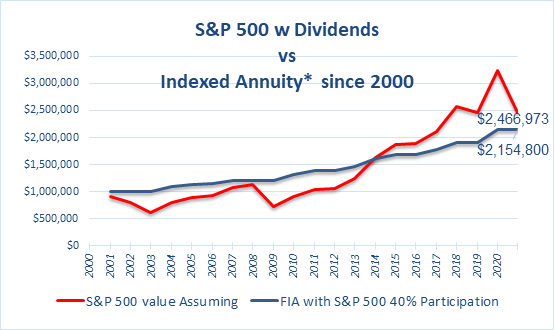
    From 2000 to 2020, there have been three major bear markets and if you owned an indexed annuity, you avoided all three. That’s “peace of mind” – not a dollar lost over 20 years. Market indexed annuities are only available from major insurance companies because only these insurance companies are financially strong enough to provide the guarantees. They prove their financial strength to regulators and rating agencies each year.


    The numbers say it all. In the chart below, the market-indexed annuity has performed nearly as well as the S&P 500 total return index (including dividends). WITH NO RISK!

    Are annuities safe? If you are a conservative to moderate investor, why not let a market-indexed annuity take some of the most important guesswork out of your retirement planning? When the indexes are up, you can make money. If markets crash or if volatility takes over, you will never lose money. Keeping this simple, if you had put $500,000 in an indexed annuity in January or February of 2020, you still have $500,000 of principal today, plus possible gains. Your principal is always intact — always at the highest level it reached, which is called the high water mark.

    You want the best of all possible worlds.

    How Does This Work? Since the insurance company guarantees the principal, they share in some of the upside, when the markets are up.


    “Don’t compare annuities to what might have been if interest rates had been higher, compare them to what is possible and available now. Now we are stuck with low rates. Trying to wait for rates to increase is going to eat away at your assets in the meantime, and there is nothing you can really gain from the effort. Low interest rates strengthen, not weaken, the case for purchasing a single premium immediate annuity.” Wade Pfau

    Ken Fisher hates annuities. Why do some financial “experts” criticize annuities? Everytime a Ken Fisher client liquidates and moves money to an insurance company for the purchase of an annuity, Ken Fisher’s firm loses annual recurring revenue. Maybe this is why Ken Fisher hates annuities?


    Which Is The Best Indexed Annuity?

    There are thousands of annuities in the market. It is our job to know them and to know which one suits you best. To do that, we listen to what you expect in order to meet your goals and objectives. Some contracts are too expensive and some carry hidden fees and charges. You want to make sure to buy the right indexed annuity from an experienced professional who only represents insurance companies with high ratings.

    Ready to start protecting your retirement assets and never lose money in the market again?


    Contact us and allow us to answer all your questions? You have nothing to lose by taking a complimentary phone call. Time does matter. A low interest rate environment forces insurance companies to lower the rates for new clients. Safety is what drives their investment decisions and in order to properly respond to lower interest rates, they will change their offers accordingly.

    Start the ball rolling and call us or fill out the simple contact form on this page or any page of the this site. We can be reached at 561-771-4647

    This image has an empty alt attribute; its file name is BEING-SMART.jpg
  • Protecting Retirement Assets. Seek Advice From Financial Consultants.

    Protecting Retirement Assets. Seek Advice From Financial Consultants.

    The right financial consultants can offer guidance about retirement, insurance, asset protection and guaranteed income strategies. These are the keys to creating and protecting retirement assets:

    Threats to consider:

    Insufficient Lifetime Income: The fact is that too many people have insufficient amounts of lifetime income. Financial consultants say the concept of liquidity in retirement is often misunderstood. The need for liquidity is different than when we are working and accumulating assets. The need for guaranteed income for life takes on new importance. There is comfortable balance of both and that is different for each one of us.


    Longevity Risk: To mitigate the risk of living too long, we should increase the amounts of guaranteed, lifetime income.


    Inflation: With interest rates at historic lows, inflation could be a retirement threat if rates move up quickly. Like un-managed high blood pressure, inflation causes unnoticed damage. Inflation is threatening due to our limited options to replenish principle.


    Incorrect Asset Allocation: Proper asset allocation is important too when protecting retirement assets. Financial consultants work with their clients to determine the proper allocation strategies.


    Rising Medical Costs: This is the retirement threat capable of immediate damage to a nest egg.  

    Loss of Spouse & Cognitive Issues– Both married and single retirees will likely deal with the issue of cognitive decline in retirement. For married couples, the loss of a spouse can be a trigger. This has proven to be a significant retirement threat, especially when one spouse assumes primary responsibility for investments. To mitigate the impact of cognitive decline, leading economists and retirement scholars agree about the great value of lifetime income.


    Investment Scams: Be careful of “too good to be true” investments. I have very good radar for scams. Feel free to contact me for an opinion.


    Fees: Fees and other charges are similar to taxes levied against your investments. They are disclosed, easy to measure and they add up. 


    Bad Advice: You know it when you see it. I meet with people in or near retirement every day whose number one objective is “no losses”. Yet, they’re retirement assets are invested in stocks and bonds. It never hurts to get another opinion and having a team of professionals with different disciplines is good prevention. Just make sure one of them is a retirement income specialist.


    Market Losses: Of all the threats to retirement assets, market losses may be the most damaging. Because we don’t have time to replenish losses with income, we can’t overcome them. A fixed indexed annuity provides upside potential while never taking losses.


    The key to security in retirement is making sure to avoid these threats. With the right strategies in place and by working with financial consultants, you can minimize most nest egg risks to gain that peace of mind you may not be currently enjoying.


    Please call me at 561-771-4647 or email me about a complimentary consultation.

  • Best Life Insurance Policy – All Done Online, No Medical Exam, No Blood. One Hour Approval.

    Best Life Insurance Policy – All Done Online, No Medical Exam, No Blood. One Hour Approval.

    Are the premiums higher if you buy life insurance without going through medical underwriting such as bloodwork or a medical examination? The answer is no. You can obtain the best life insurance policy online without a visit from a medical professional. That means the best rates and the best policies are available online. Accelerated underwriting does not mean expensive, guaranteed issue. The insurance company still underwrites each individual policy but in a completely new way. Some life insurance companies are leading the way by using information and data they believe is better.

    Although this may be counter-intuitive, you do not pay more. Buying life insurance online is not “buying direct” from the insurance company either. Life insurance companies do not sell policies direct to consumers. They sell only through licensed insurance agents, without exception. Some insurance companies tried going direct, without success. Life insurance is sold, not bought.

    Behind every online site selling life insurance, there is a licensed life insurance agent. For every sale, the insurance company pays a commission to the licensed agent named in your application. You may not realize a life insurance agent is writing the policy, but in fact, it is required by law. Some of these online agencies are hoping consumers believe there is an advantage in going “direct” and cutting out agents. It helps to know that online sites are no different than any other insurance agents or agencies.

    Why It Matters.

    Now that you know there is an agent getting paid a reasonable, non-negotiable commission, you want to always use the help and guidance built into the pricing of the policy. The insurance companies want educated consumers. Some life insurance buyers may incorrectly assume that buying online is “going direct”.

    State of the Art.

    In conclusion, you can now purchase the best life insurance policy online and get it done WITHOUT A MEDICAL EXAM, without lab tests (non blood or urine) or face-to-face visits, if that is what you prefer. The maximum is $5,000,000 per person and we have companies that write up to age 65 without medical evidence. The whole process can be done within an hour. 

    Contact us for a quote to apply and buy. Reach Ted Bernstein at 561-771-4647 or by email. We are close. People often search for “life insurance near me” or “life insurance agent near me” and we are one of the results. Online, we’re all close for business purposes. It truly is one of the great benefits of the Internet. Check out our 5 Star rating on Google or on our testimonial page.

  • Best Options Before a Term Policy Expires.

    Best Options Before a Term Policy Expires.

    The two most important considerations to focus on before a term policy expires are your current health and the policy’s conversion option. Every option you will face involves these considerations. Whether you keep, convert or sell the policy, current health and convertibility will be factors. The best time to deal with the end of a term policy is well before its end, allowing for enough time to consider a plan based on the options available in the contract. This way, you retain control over keeping the coverage or shopping for a new policy.

    Long duration, guaranteed term insurance is a relatively new product in the life insurance industry. It started getting popular about 25 years ago. Low premiums have enticed many insurance buyers to overlook some disadvantages. For example, let’s assume a 35 year old person bought a 20 year term policy, 20 years ago. Twenty years later, around age 55, the policy is expiring. What we find is that a very large percentage of people in this boat want to extend the coverage, but they cannot. There are many reasons for this which I cover extensively on this site.

    Before a policy expires, you want to be aware of the following:

    1. If the policy served its purpose, you can walk away, assuming there is no secondary market value. If you are over age 70 with some significant health issues, you might want to explore the secondary market to determine its value to a settlement investor.
    2. Another option is to convert your policy to a permanent one from the company that issued the original term coverage, after making sure the conversion privilege is still in effect and available to you. DO NOT ASSUME IT WILL BE. The conversion option is the single most misunderstood provision in term insurance. Most policies limit the time you can convert. Once it passes, you are out of luck and you will then need to prove evidence of insurability to the insurance company. They will want new and updated health information, new blood and other labs, at the very least. They will re-underwrite you again as if you’re a new policyholder. If, however, you are ABLE to convert WITHOUT evidence, you still may NOT want to exercise this option. It will depend on your health.
    3. Another possibility is to buy another term policy if you are insurable. If you are, shop the market with an insurance professional who can find you the most competitive policy at that time. No matter what you do, you are paying for the professional to assist you. If you buy a policy and use no help from anyone, the insurance company will pay the full commission to the designated agent assigned to your purchase. There is no way around this. Like the car business, you cannot call Ford and bypass the dealerships. My point is to take advantage of what you are paying for and find an agent you are comfortable working with.
    4. Or, you can buy a permanent policy. Beforehand, shop the market with an insurance professional who can maximize the value of your purchase, especially with a permanent policy. See point #3. Be selective and try to find a professional with experience, an impeccable reputation and solid referrals.
    5. Another option is to extend the coverage by paying the “renewal” premium offered by most policies. The rate will be much higher than the rate you’ve been paying. This option usually means the insured is in bad health and has no other options.

    The most important thing I can offer as a takeaway is to review the policy every couple of years and talk through these options to be mindful of when the conversion date expires. Planning around that date will prove to be beneficial in the long and short run.

    Give us a call at 561-869-4500 or email me at TB@LifeCyclePlanners to get started. I offer a complementary conversation about anything on your mind concerning your insurance coverage or succession plan.

  • Annuity Glossary, Terms & Definitions

    Annuity Glossary, Terms & Definitions

    Frequently used annuity terms:

    Annuitization involves converting your accumulated retirement assets into a series of periodic payments that last for a period of time of your choosing, in accordance with the provisions of the annuity contract.


    Deferred Annuities are annuities that can be funded through a single premium or through flexible payments over time. Can potentially help you to accumulate money for retirement, especially over an extended period of time. Your money grows tax deferred, which means you pay no taxes on earnings until you withdraw your money.


    Did you know that most fixed annuities have no fees? Over time, the absence of any fees is powerful.

    Distribution Period is the period of time, either a specified number of years or lifetime, over which distribution payments are made to the annuitant. Earnings become taxable when the annuitant begins to receive payments. The payout during the distribution period can either be fixed or variable.


    Fixed Annuities are annuities that guarantees you a specified rate of interest for a specified amount of time. Offers preservation of your assets and protection from market volatility. There are many types of fixed annuities with varying degrees of complexity.


    Flexible Premium Annuities are funded over a period of time, generally years. Allows you to pay premiums of differing amounts (within a stated minimum and maximum) on a set schedule or randomly. Your assets accumulate on a tax-deferred basis and can fund either fixed or variable deferred annuities.

    Immediate Annuities These begin payments for life or for a specified amount of time in exchange for your one-time contribution. Regular payments can be received on a monthly, quarterly, semiannual or annual basis. A portion of each payment represents taxable interest, and the other portion is a tax-free return of your principal. These can be great for retirement planning purposes, when maximum income is important.


    Premature/Early Withdrawals (Distributions): Withdrawals are reported as income and are subject to ordinary income tax treatment (as opposed to capital gains or dividend income), and if made prior to age 59½, may be subject to an additional 10% federal income tax penalty.  In addition, company imposed surrender charges may apply to certain withdrawals.


    Single Premium Annuities: They provide a way to turn a large sum of cash into guaranteed income. For those who have cash from an inheritance, legal settlement, business sale, etc., can fund an immediate or a deferred annuity. For those nearing retirement, who have assets accumulated in a retirement plan or other savings vehicle, can fund an immediate or a deferred annuity.


    Tired of earning no interest on your money? Need a higher rate of return? Most people are not aware of how a MYGA can get you a 3% guaranteed rate for 3 years. Banks and CDs paying close to zero! A MYGA is safe, tax deferred and short term. Get a quote in less than an hour. Why not earn $9000 in 3 years instead of a few hundred dollars?


    Return of Premium Rider: guarantees AT LEAST 100% of what you paid in premium whenever you surrender. For many people, their only concern about making an annuity purchase is the penalty for early surrender. Not all insurance companies offer this valuable feature and most annuity salespeople don’t offer it because they are paid less and commission is vulnerable for several years.


    Systematic Withdrawals: allow you to withdraw money from the accumulated value of your contract on a regular schedule – making it an effective way to supplement income either before or after retirement. Systematic withdrawals are also flexible.


    Variable Annuities: offer opportunity for asset growth through a variety of investment choices tied to market performance. With their greater opportunity for growth, comes greater risk. Variable annuities are subject to loss of principal.


    Withdrawal Charges, Surrender Charges, Surrender Penalties: are charges that typically decreases annually until they reach zero.


    Fixed Indexed Annuity With Income Rider: creates guaranteed income for life. The income level grows until you activate the rider and begin taking lifetime income. There are contracts with inflation riders and long term care riders that increase the income payments.


    More annuity terms, definitions and frequently asked questions:

    A

    Account value

    The amount of money in an annuity, working for the owner, before possible surrender charges.

    Accumulation phase

    The time frame during which the account value has the potential to grow. Also known as growth phase or growth period.

    Advisor

    A qualified person who can help annuity buyers understand their options and make financial decisions pertaining to their financial goals and objectives.

    Simpler term: Financial professional, Financial advisor, Financial consultant

    Annuitant

    A person who will receive the income payments from an annuity. (They could be the direct owner of the annuity or another person chosen by the direct owner, and they are the person whose lifetime income the payments are based on).

    Annuitize

    When the annuity leaves the accumulation phase, turning the current account balance into a series of periodic income payments, either for a set period of time or for life.

    Annuity

    A financial product that offers guaranteed lifetime income with the potential of growing the principal.

    Risk Appetite 

    The level of market risk that is acceptable to annuity owners. Risk comfort level, Risk tolerance, Degree of certainty, Risk appropriateness, Investor confidence.

    B.

    Beneficiary

    The person designated to receive any remaining account balance or income payments once the owner is deceased.

    Benefit

    A feature that can provide added value or protection to the policyholder and/or beneficiaries, sometimes at an additional cost. Optional benefit, Rider, Waiver

    Benefit to heirs

    The balance that is paid to a beneficiary, typically the remaining account balance or income upon the annuitant’s death. Beneficiary benefit, Death benefit, Legacy benefit, Legacy, Legacy protection benefit, Family protection

    Annuities have decreasing surrender charges that are usually gone in 7-10 years. The purpose of surrender charges is to allow the insurance company to invest in longer term assets, creating better yields for policyholders.

    C

    Cap

    The maximum interest credited to an annuity at the end of a selected time period. The annuity owner will choose the time period that’s best from available options.

    Charge

    The amounts deducted from the contract, which may include setting up the annuity, adding optional benefits, etc.

    Simpler term: Fee or Cost

    Contribution

    The payment paid into a contract. For most annuities, this is the paid in money.

    Simpler term: Premium, purchase payments

    Co-owner or Joint income option

    An optional benefit that offers guaranteed withdrawals for life for both you and a loved one.

    Related terms: Joint option, Spousal option, Income for two, Joint guaranteed lifetime withdrawal benefit, Joint protected lifetime withdrawal benefit

    Commission

    The amount of compensation paid by insurance companies for the sale of annuity products. The compensation is paid by the insurance companies, from its balance sheets, not the assets of the policyholders. 

    Contract value, account value or account balance

    The amount of money working in the annuity.

    D

    Death benefit

    A benefit paid to beneficiaries, typically the remaining account balance or income upon death. Legacy benefit, benefit to heirs, legacy protection benefits, family protection

    Decumulation 

    The point you when an annuity ends the accumulation phase and begins to make income payments. Spending phase, income or distribution phase.

    Deferral bonus

    A bonus amount that may be added to an annuity for each year income is deferred. Typically, this bonus is added each year, up to a certain age.

    Deferred annuity

    A type of annuity that delays payments until the policy owner chooses to receive them, while providing an opportunity for growth during the deferral period. 

    Distribution phase

    The point when an annuity begins paying income from an annuity.

    Diversification

    Strategically spreading the account value among different types of investments to help reduce the impact of market downturns. Diversification does not guarantee a profit or protection against a loss.

    E

    Earnings sensitive adjustment

    Additional income received on top of the guaranteed amount, or in addition to any other income increase. This additional income is based on the market performance rate, and allows for additional earnings of otherwise permissible withdrawals. AKA bonus income increase.

    F

    Family protection

    A benefit that pays the beneficiary the remaining account balance or income upon death. Consumer friendly terms are beneficiary benefit, legacy benefit

    Fee

    The amounts associated with owning an annuity, which may include setting up the annuity, adding optional benefits, etc. Fees can be embedded in the annuity contract or in addition to the premium.

    Fiduciary

    A qualified financial professional who is required to help consumers make financial decisions in their best interest. (A fiduciary is not the only type of financial professional required to make financial decisions in the best interest of their clients. All professionals should comply with best-interest requirements, as a matter of good practice.)

    Financial advisor

    A qualified person to help consumers understand their options and make financial decisions to work toward their financial goals. Consumer friendly terms include financial professional, advisor, financial consultant.

    Financial consultant

    A qualified person who does not earn commissions by helping consumers understand their options and make financial decisions to work toward their financial goals.

    Fixed account

    An account that earns a guaranteed interest rate and is not invested in or tied to the market.

    Fixed annuity

    A type of annuity that delivers 100% protection from market downturns with potential for earned interest. Many fixed annuities provide the benefit of a guaranteed interest rate, in addition to downside protection and the potential for earned interest.

    Fixed indexed annuity

    An annuity that guarantees principal protection from market downturns with the potential for growth tied to a market index by guaranteeing no principal loss and limited returns.

    G

    Growth period

    The period when annuity principal has the potential to grow. (Some annuities allow for additional contributions over time.) More consumer friendly terms include growth stage and accumulation phase.

    Guaranteed lifetime income

    The payments from an annuity that are payable for life. Unused principal is paid to the contract beneficiaries in most types of annuities.

    I

    Immediate annuity

    An annuity that begins paying out guaranteed income within one year of the purchase date, either for life or for a selected time period. The payments consist of interest and mortality credits.

    Income stage

    The point when the annuity owner begins receiving income from the annuity. Related terms: Distribution phase, decumulation phase, spending phase

    Index participation rate

    For some indexed annuities, when the underlying index value increases, the contract is credited with a portion of that increase based on the participation rate. For example, if the market went up 10% and the annuity’s participation rate was 80%, the annuity would be credited with an 8% return, or 80% of the gain. Participation rates are typically not guaranteed. They are subject to increase or decrease, in most contracts.

    J

    Joint option or guaranteed lifetime withdrawal benefit

    An optional benefit that offers guaranteed income withdrawals for life, for two people, usually for spouses. More consumer friendly terms include joint income option, spousal option, joint lifetime withdrawal benefit.

    L

    Legacy

    A benefit that pays the contract beneficiary the remaining account balance, a predetermined level defined in the contract, or income upon death. Other consumer friendly terms are beneficiary benefits, death benefit, legacy benefit, legacy protection benefit and family benefits.

    Liquidity risk

    The risk that annuity principal may need to be accessed sooner than anticipated, which could result in penalties or impact performance.

    Living benefits

    Optional benefits available for an additional cost that can offer guarantees, such as a minimum level of income for life or guaranteed income benefits.

    Longevity risk

    The chance of outliving one’s wealth and not having enough money to live.

    M

    Market risk

    Like most investments, this is the chance of losing money due to unforeseen market downturns.

    Market value adjustment

    Allows for permanent increases to be withdrawn from the income base when the account balance, or total amount of money in the annuity, exceeds a certain level. This may occur on an annual or daily basis, depending on the annuity.

    Related terms: Market value increase, permanent income base increase

    Market value increase

    Allows for a permanent increase from the annuity income base when the account balance, or total amount of money in the annuity, exceeds a certain level. This may occur on an annual or daily basis, depending on the annuity.

    Market volatility

    Rate at which markets change price. The way stocks, bonds and other market investments change in value. This market movement may affect the value of an annuity or other investments. Some annuities protect against volatility even when the markets go down.

    P

    Payment/Payout

    Amount of income paid from an annuity with a set frequency.

    Simpler term: Income payments, contract payout

    Period certain

    A payout option that allows annuity owners to choose when and how long to receive payments, including beneficiaries.

    Premium

    For most annuity types, this is the money paid into the annuity.

    Price

    The amounts associated with owning an annuity, which may include setting up the annuity, adding optional benefits, etc.

    Product

    They type of annuity used to pursue specific goals.

    R

    Rider

    A feature that can provide additional benefits or protection to the contract for the owner or their beneficiaries, often at an additional cost.

    Risk tolerance

    The level of market risk that is acceptable for each annuity owner.

    S

    Solution

    The strategy that is used to pursue specific financial goals.

    Simpler terms: Strategy, vehicle or product

    Spending phase

    The point when the annuity starts making distributions, the decumulation phase

    Spousal continuation

    An option to transfer ownership or continuation of the guaranteed income to a spouse upon death.

    Spousal option

    An optional benefit that offers guaranteed withdrawals for life for a spouse. The joint income option

    Sub-accounts

    The underlying investment choices available in a variable annuity. These typically include stock, bond and money market funds. The annuity investment options.

    Surrender Charge

    A penalty that is paid to withdraw a certain amount of money from an annuity before the end of a set time period. For example, the annuity may allow for a withdraw up to 10% of the income base within a period of time. If a withdrawal of more than 10% is taken during this time, there will be a fee imposed.

    Simpler term: Early withdrawal fee, surrender charge, withdrawal penalty

    V

    Variable annuity

    A financial product that offers the potential to grow money through various market investment options and that can provide income during retirement. Some variable annuities offer optional benefits, available at an additional annual cost, that can protect the lifetime income from market downturns.

    Please contact me at 561-869-4500 or complete the contact form on this page to schedule a complementary discussion. Or visit me on: https://www.advisorycloud.com/profile/Ted-Bernstein

    Annuity glossary, annuity terms, annuity definition, best annuity

  • New Alternative Creates Customized Payouts of Life Insurance Proceeds to Protect Beneficiaries.

    New Alternative Creates Customized Payouts of Life Insurance Proceeds to Protect Beneficiaries.

    For the past 200 years, life insurance companies have only offered a lump-sum payout of policy proceeds to beneficiaries. For many, this is not ideal considering these income tax proceeds are squandered in less than 5 years. Ask any life insurance buyer if they intend for the proceeds to be spent in less than 5 years.
    Life insurance buyers want choices. In fact, a high percentage of life insurance owners do not want a lump-sum payout. Instead, they want a policy that gives them the option to create a customized and guaranteed income stream for their beneficiaries that cannot be mismanaged. The Installment Option instructs the insurance company to make guaranteed, pre-determined income payments over time. These payments are selected when the policy is issued by the policy owner. The best life insurance policies today give policy owners flexibility and options; the more, the better.


    The Installment Payout Option allows policy owners to create a customized schedule to fit their family needs and guarantee a protected income stream for their beneficiaries, up to 10, 20 or even 30 years.
     Premiums payments – up to 50% less for guaranteed results or the
    total benefit is increased as much as 50% for the same premium.
     The annual payments are pre-determined and guaranteed,
    regardless of economic conditions or other variables.
     Ability to customize the death benefit payments to meet individual
    planning objectives.

    Proceeds are paid according to a pre-determined schedule, selected by the policy owner at the time of purchase. In the past, a lump-sum payment was the only option available. The Installment Option eases concerns about lump-sum payments being mismanaged.

    Protect Proceeds For Beneficiaries

    What is the Installment Life Payout Option?
    Rather than your beneficiary receiving a lump-sum payment at the time of
    death, the Installment Payout Option gives you the power and control to choose guaranteed, pre-determined installment payments when the policy is purchased.
    Is the Installment Option Less Expensive ? Can I Buy More Life Insurance With the Same Premium Payments?
    Yes, this option is less expensive. The longer the deferral period, the lower the premium payments will be. Premiums can be as much as 40% less on an annual basis.

    Is the Installment Option Better Than a Lump-Sum Option?
    Neither option is “better” than the other. An increasing number of life
    insurance buyers are concerned about the risks of leaving a lump-sum death benefit to their beneficiaries. For them, the Installment Option may be best. Life insurance owned for estate tax planning is a good example of when a lump-sum option may be a more appropriate alternative.
    How is the Deferral Schedule Determined?
    We encourage every life insurance buyer to meet with a life insurance professional to consider these options, and others. Your income, debt levels,
    other assets, fixed and variable expenses, education, retirement assets and inflation are some of the elements in the calculation.
    Can I Change the Payout Option from Installment to Lump-Sum?
    Some insurance companies allow for this. Unlike the lump-sum option that is very limited from a planning perspective, the Installment Payout Option allows for customization by each policyholder.
    Can I choose a Blend of Lump-Sum and the Installment Option?
    Yes. Most people appreciate the ability to customize their life insurance
    policy by combining a lump-sum payment with installment payments over time.
    Can I Upgrade My Existing Insurance to the Installment Option?
    Yes. By doing so, you may be able to lower the premium payments or
    increase the death benefit for the same premium you pay now.
    Can a Beneficiary Make Changes to the Installment Schedule?
    No. However, the installment payments are an asset that can be sold at a
    discount. We recommend a trust be considered as the policy owner, with an
    informed trustee to ensure the insured’s intent is honored.
    What if My Health Has Changed Since Last Purchasing Life Insurance?
    If you have had a material change in health, be cautious about giving up
    any existing coverage without a careful analysis. Consult with us to help evaluate your options. By choosing the Installment Payout Option, you may be able to neutralize the impact of a higher premiums.
    What Insurance Companies Underwrite the Installment Payout Option?
    The Installment Option is available from several of the most highly rated life insurance companies in the United States.

    Please call me at 561-869-4500 or email me, Ted Bernstein, about a complimentary review of your existing policies.